

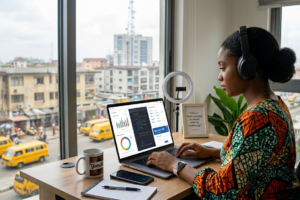
You have done the hard part. You found the role, sent the application, and heard back. You have a video interview scheduled with a company based in London, Amsterdam, Toronto, or San Francisco. Now what?
If your interview preparation instinct is to review your CV, practise answers to “tell me about yourself” and “what is your greatest weakness,” and make sure your outfit is professional, you are preparing for the wrong interview. Those preparation habits are designed for a traditional in-person interview at a Nigerian organisation. A remote interview at an international company is evaluating something different, using different questions, and watching for signals that most Nigerian candidates have never been told about.
This guide will tell you exactly what those signals are and how to send the right ones.
What International Remote Employers Are Actually Trying to Find Out
Before we get into specific preparation tactics, understanding the underlying evaluation framework matters enormously. International companies hiring remote workers are not simply trying to confirm that you are qualified for the role. They already have a reasonable degree of confidence in your qualifications from your CV. That is why they invited you to interview. What they are genuinely trying to assess in the interview is a different set of questions entirely:
1. Can you communicate clearly and efficiently in an asynchronous, written-first environment?
Remote work runs on Slack, email, Notion, and Google Docs. The majority of communication is written, not verbal. An employee who requires constant verbal clarification, who writes ambiguously, or who cannot structure their thoughts in writing creates a disproportionate burden in a remote team. The interview is partly an assessment of your written and verbal communication quality and not just your accent, but your precision, your ability to listen and respond to exactly what was asked, and your ability to structure complex ideas clearly.
2. Will you manage yourself, or will you need managing?
In an office, a manager can walk over to your desk. In a remote team, the manager cannot see you working. They need evidence that you can identify what needs to be done, prioritise it correctly, and deliver it without being prompted. This quality, which is sometimes called “low maintenance” or “high agency”, is one of the most sought-after characteristics in remote employees and one of the hardest to demonstrate in an interview unless you know it is being evaluated.
3. Are you reliable enough to be trusted across time zones?
For Nigerian applicants specifically, international employers carry some degree of concern about infrastructure reliability, power, internet, and the ability to be available and responsive during agreed hours. They will not always ask about this directly. But it is in the room, and your job is to address it proactively.
4. Can you work effectively with people you have never met in person, across cultural contexts?
Remote teams are almost always culturally diverse. Your ability to read communication styles different from your own, to give and receive direct feedback without taking it personally, and to build working relationships through a screen rather than in a shared physical space… these are the “remote culture” skills that international employers are watching for.
Before the Interview: The Technical Setup That Communicates Before You Say a Word
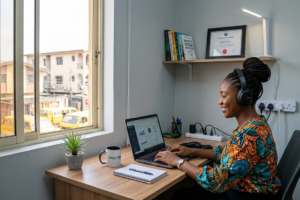
The first thing every international interviewer notices is your setup. Before you say a single word, they have already formed an impression based on your video quality, your audio quality, your background, your lighting, and whether you joined on time. This impression takes about ten seconds to form, and it shapes how they hear everything you say afterwards.
This is not about having an expensive setup. It is about having a professional one. Here is the specific checklist:
Camera
Your laptop camera is acceptable for most interview contexts. Position it at eye level, not looking up at your face from below, not looking down from above. Eye-level engagement is the most natural, most professional framing. If your laptop sits on a desk, put it on a stack of books to raise the camera to face height.
Lighting
The single biggest technical upgrade you can make at zero cost: sit facing a window with natural daylight rather than with the window behind you. A window behind you creates a silhouette and makes your face dark and hard to read. A window in front of you lights your face clearly and professionally. If you are interviewing in the evening, a simple desk lamp positioned in front of you at face height achieves the same effect.
Audio
Audio quality matters more than video quality in remote interviews. A ₦8,000 USB headset with a microphone will sound cleaner and more professional than a ₦200,000 laptop with built-in microphones in a room with background noise. Background noise (neighbours, generators, traffic) is the most common audio problem in Nigerian remote interviews and the most avoidable with a headset.
Before every interview, test your audio. Call a friend and ask them to honestly describe what you sound like. Record a 30-second voice note and listen to it on headphones. You will hear things you cannot hear in real time.
Background
A plain wall, a tidy bookshelf, or a blurred virtual background (available in Zoom and Google Meet) is professional. A busy room with laundry visible, family members moving in the background, or bright windows that create contrast issues is not. You do not need a studio. You need five minutes of tidying and a deliberate choice about where you sit.
Power and Internet
This is where Nigerian candidates lose interviews they were otherwise winning. A power cut during a critical interview moment, or the internet dropping repeatedly, communicates unreliability regardless of how strong your answers are. Have a mobile data backup ready before every interview. If possible, conduct the interview on a wired connection rather than WiFi. And have your laptop fully charged with a UPS or power bank behind it so that NEPA does not decide your career for you.
Join Five Minutes Early
This is both a practical and a signalling decision. Joining five minutes early lets you check that your audio and video are working in the actual interview room rather than discovering a technical problem after the interviewer has joined. It also signals punctuality and preparation; qualities that international employers value highly in remote candidates, specifically because they cannot supervise you once you start.
During the Interview: The Questions and What They Are Really Asking
“Tell me about yourself.”
In a remote interview at an international company, this question is rarely an invitation to summarise your CV chronologically. It is an invitation to tell a concise, compelling professional story that explains who you are, what you are excellent at, and why you are here in this interview. Keep it to 90 seconds maximum. End with a sentence that connects your background explicitly to this specific role and company.
The structure that works: [Who you are professionally in one sentence] + [Your most relevant experience or achievement in two sentences] + [What brings you to this role specifically in one sentence].
“How do you manage your time and prioritise tasks when working remotely?”
This is the “will you manage yourself” question. They are not looking for a generic answer about to-do lists. They are looking for evidence that you have a real, functioning system for managing your own work without external supervision.
Answer with specificity: the actual tools you use (Notion, Trello, Google Calendar, Asana), the actual routine you maintain, and, if possible, a specific example of a time you managed a complex workload independently and delivered on multiple commitments simultaneously. “I use Notion to maintain a daily task list prioritised by urgency and impact, I block focus time on my calendar for deep work and protect it deliberately, and I do a weekly review every Sunday to adjust priorities for the coming week” is a genuinely reassuring answer. “I am good at managing my time” is not.
“Describe a time you worked across different time zones or with teammates you had never met in person.”
If you have done this, describe it with specific details: who you were working with, what the timezone spread was, what tools you used to stay aligned, and what the outcome was. If you have not done this in a formal role, draw from any adjacent experience: coordinating with suppliers or partners in different parts of Nigeria, managing a project with a distributed team, or contributing to an online community or project with international members. The underlying skills being assessed (asynchronous communication, written clarity, reliability across distance) are what matter, not whether the distance was Lagos to London or Lagos to Abuja.
“How do you handle situations where you are blocked or waiting on input from a colleague?”
This question is evaluating your initiative and your communication habits when things are not moving. The weak answer is “I wait for them to respond.” The strong answer demonstrates that you try to unblock yourself first, communicate your blocker clearly and early so it does not become a surprise problem, and find alternative productive work to do rather than sitting idle. Give a specific example.
“What does your home office setup look like? How do you handle power or connectivity issues?”
Some interviewers will ask this directly. Others will not, but they are thinking about it. Either way, address it proactively. Describe your setup clearly and specifically. Mention your backup internet solution. Mention your power backup. Mention the quiet, dedicated workspace. This answer is not just about your infrastructure, it is about your seriousness. A candidate who has thought about and prepared for these practical realities communicates that they are genuinely ready for remote work, not just hoping it works out.
“Why do you want to work remotely rather than in a traditional office?”
The honest answer for many Nigerians involves economics: the dollar/pound income differential with Nigerian living costs is transformative. There is nothing wrong with this, but it is not what an international employer wants to hear as your primary motivation because it suggests you are arbitraging their compensation rather than genuinely wanting to contribute to their mission.
The better answer combines an honest, practical element with a genuine professional one: “Remote work gives me access to opportunities at the calibre of yours that are simply not available in my local market at this time. But beyond the access question, I have genuinely found that I do my best work in a structured, independent environment where outcomes are measured on results rather than visibility. I have built systems to be highly effective that way, and I am looking for an organisation that trusts and values that.”
The Preparation Work That Makes Everything Else Easier
Ninety per cent of remote interview success is determined before the interview begins. The candidates who consistently perform well in remote interviews share one characteristic: they know the company thoroughly before they sit down.
Not just the website’s About page. The company’s LinkedIn updates from the past three months. Their most recent blog posts or published articles. Any press coverage. The interviewer’s LinkedIn profile, their background, what they write about, what they seem to care about professionally. The specific team or product area the role is in, and what that team has been working on.
When you walk into an interview with this knowledge, three things happen. Your answers are more specific and relevant, which makes them more credible. You can ask genuinely informed questions at the end, which signals serious interest. And you project a confidence that comes from preparation rather than performance. Experienced interviewers can feel the difference.
Questions to Ask at the End And Why This Matters More Than Most People Realise
The invitation to ask questions at the end of an interview is not a formality. It is an evaluation of your curiosity, your commercial awareness, and your genuine interest in the role. “Do you have any questions for us?” followed by “No, I think you have covered everything” is a red flag for international remote employers. It signals incuriosity and disengagement.
Strong questions for a remote job interview:
- “How does the team handle communication across time zones? Is there an expected overlap window, or is the majority of collaboration asynchronous?”
- “What does success look like in this role at the 90-day mark? What would you want someone to have accomplished by then?”
- “How does the team build relationships and maintain cohesion without regular in-person contact? Are there team retreats or virtual touchpoints?”
- “What is the biggest challenge facing the team or this function right now?”
- “How are performance and impact measured for this role?”
These questions demonstrate that you are thinking about the job, not just trying to get it. They show that you understand remote work as a distinct working model with its own challenges, not just an office job done from home. And they give you genuinely useful information to help you decide whether this is the right opportunity, which is, after all, what interviews are supposed to be for on both sides of the table.





Deprecated: File Theme without comments.php is deprecated since version 3.0.0 with no alternative available. Please include a comments.php template in your theme. in /var/www/worklandhq/wp-includes/functions.php on line 6260